
Bonsai Heirloom — Site Design & Product System
Brand identity & creative direction · 2025–present
Site Audit · Shopify Foundation Rebuild · Brand Guide · Photoshoot Direction & Styling · UX/UI Improvements · Sibling-Product Linking · Product Range Architecture · PDP Content System · Drop-Page Architecture · Ongoing CD Oversight & Content Approval Context
Bonsai Heirloom came in with a single, unambiguous brief: improve conversion. A premium specimen brand with a loyal earned audience but a Shopify foundation that was holding the storefront back. What began as a conversion fix has grown into an ongoing creative-direction partnership — the storefront now supports a full tiered product range without the brand story fracturing.
Improve conversion rates. A narrow, focused mandate — not open-ended brand work, but a specific business outcome to deliver.
bonsaiheirloom.com

The conversion brief was narrow but the path to it was structural — the foundation needed rebuilding before any tactical interventions could hold.
- Site audit
- Rebuilt the Shopify foundation — consolidated per-SKU PDP templates (each product had been its own one-off page) into a single reusable PDP template
- Created the brand guide
- Refined the product shot list
- Planned and directed multiple on-location lifestyle and product photoshoots
- Improved UX/UI — linked sibling products, made site navigation substantially easier
- Ongoing CD oversight + approval of the weekly newsletter and bi-weekly YouTube videos that drive Bonsai Heirloom's core customer base (~280K social audience earned across YouTube 202K, TikTok 40K, Instagram 37K, Klaviyo 11.6K — all without paid acquisition)
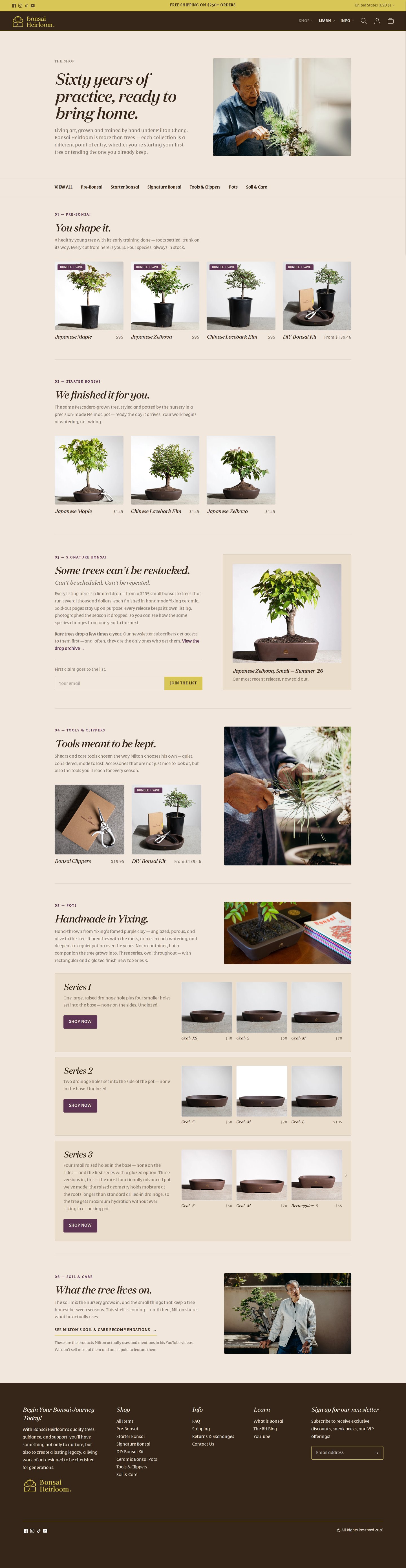
bonsaiheirloom.com — the shop landing
bonsaiheirloom.com/products/...

Left: the reworked shop landing — sixty years of practice as the opening line, then the tier ladder told as a story: "You shape it" through the Signature drops. Right: a representative product detail page from the consolidated PDP template — one reusable structure in place of a full catalog of one-off pages.
Approach — Phase 2: Building the Architecture the Brand Had EarnedA year in, the brand had earned the right to expand — new product lines, new drop cadence, a growing collector market. But the storefront's IA and copy were still built around a single-tier catalog. Adding pre-bonsai starter kits and heirloom-tier signature specimens to the existing system would have muddied the story that made Bonsai Heirloom premium in the first place. Phase 2 was the architecture rebuild — the systems the storefront needed to tell a wider range of stories without losing what made it work.
- Product range ladder. Defined a tiered product architecture — pre-bonsai (DIY-friendly starter kits), starter (starter trees in Melmac pots), heirloom (specimen trees with Milton's finishing), and Signature (the collector tier). Same trees at the root; the pot, the finishing, and the audience are the product.
- PDP content system. Replaced legacy per-listing variation with a five-block architecture where each block does one job — arrival bullets in the body, species-specific storytelling in Product Details, tier context in a dedicated block, buyer disambiguation in a "Who's It For" block, and every care question routed to a single "Common Questions" block.
- Drop-page architecture. Rebuilt the previous-drops page as a browsable archive rather than a sold-out graveyard. Sold-out product pages stay live so the scarcity story of a limited drop lands even after the drop closes, with a "missed this drop?" newsletter capture on every one.
- Content and copy rules. Established the evergreen-content rulebook — no hardcoded prices in prose, no direct competitor comparisons, no unverified provenance claims. Accuracy is non-negotiable in the specimen market.
Left: the tiered product ladder — same trees, different products. Center: the five-block PDP architecture, one job per block. Right: the previous-drops page, rebuilt so limited drops carry their scarcity story past the sell-out moment.
OutcomeEight months in, conversion has nearly doubled (0.40% → 0.78%) on 25% less traffic. Quality-over-quantity outcome — the brand attracts a smaller, higher-intent audience that converts and returns, with AOV held at the premium price point.
A year in, the storefront now supports a full tiered product range without the brand story fracturing. The earned audience continues to grow through organic content alone, and the product architecture is ready for the next set of drops and the Signature line.
Sep 2025 → Apr 2026 (Shopify DTC):
+95%
CONVERSION
21%
REPEAT (60D)
−25%
TRAFFIC
280K
EARNED AUDIENCE
Source: GA4 sessions + Shopify Admin API. Pure DTC (Shopify only, no marketplaces); earned audience across YouTube 202K, TikTok 40K, Instagram 37K, Klaviyo 11.6K — no paid acquisition. Phase 1 metrics reflect Sep 2025 → Apr 2026; Phase 2 architecture work Jun–Aug 2026, with new-tier launch metrics pending.
Shopify foundation rebuild, brand guide, UX/UI, photo direction, product range architecture, and PDP content system: led and directed by Kathrine Gilmer of Aster House, as contract creative director for 88 Venture Studio.
← View all work Work with us →
Keep Exploring

